*By Comrade Ikhuenbor Felix Igbinevbo
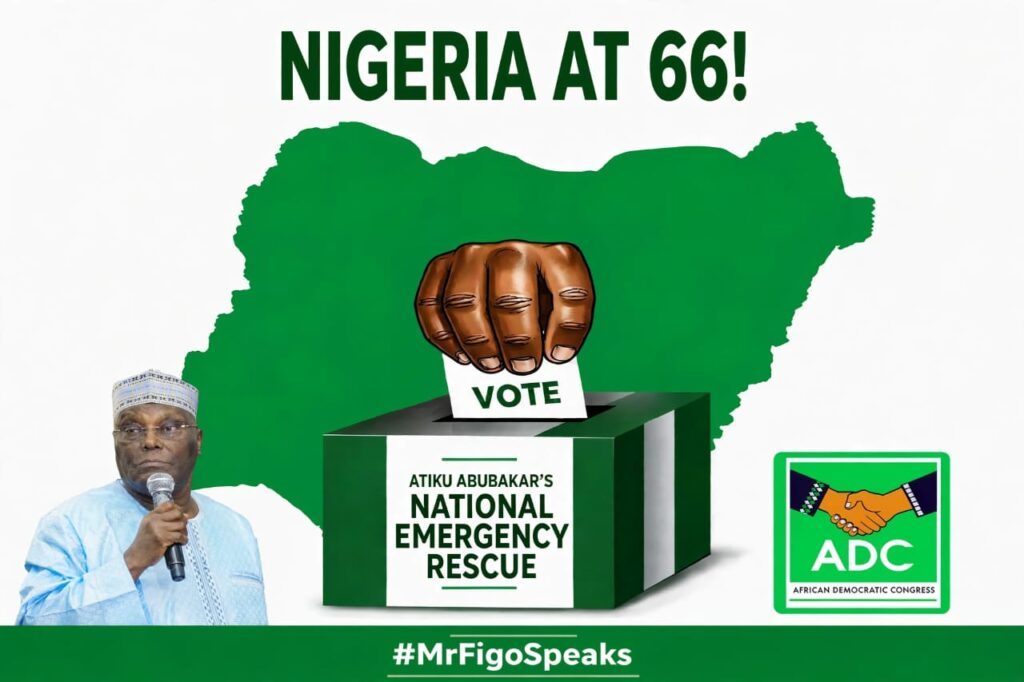
Today, Nigeria marks 66 years of independence.
Sixty-six years is not a small period in the life of any nation. It is an age at which a country should have accumulated enough experience to understand its challenges, enough institutional maturity to confront them, and enough wisdom to translate its vast human and natural resources into a better quality of life for its citizens.
But as Nigeria turns 66, we must ask ourselves a difficult question: what exactly do we have to show for 66 years of independence?
Yes, Nigeria has recorded progress in several areas. Nigerians have achieved remarkable things individually and collectively, both at home and across the world. Yet the broader national picture remains deeply troubling. The promise of independence has not translated into the standard of living, security, economic opportunity and responsible governance that Nigerians deserve.
We cannot continue to celebrate age while ignoring condition.
For millions of Nigerians, independence has not brought the freedom from poverty that should accompany economic growth. It has not brought the security that allows families to sleep peacefully, nor the dependable public services that make ordinary life less burdensome. For too many citizens, daily existence has become an endurance test.
What makes the situation even more painful is that Nigeria has not always been this stagnant.
There were periods when the country was laying foundations for a stronger future — developing infrastructure, building institutions, expanding industries and making measurable progress in education, agriculture, transportation and public administration.
So where did we begin to lose our way?
For me, the answer lies in the political journey of the last decade — a period that began with a powerful promise of “Change.”
Nigerians were promised a departure from the failures of the past and the beginning of a new national direction. Millions embraced that promise because they believed the country was about to turn a corner.
But the change Nigerians expected did not produce the transformation they were promised.
Instead, the country gradually moved from the expectation of progress to the experience of increasing hardship. What began as “Change” eventually gave way to “Renewed Hope.”
Yet today, many Nigerians are asking a painful question: renewed hope for whom, and where is that hope?
The promise of change became, for too many citizens, an experience of regression. The promise of renewed hope now confronts a population struggling with the rising cost of living, insecurity, unemployment, energy challenges and declining purchasing power.
The tragedy is not merely that Nigerians are suffering. It is that many Nigerians no longer have a clear sense of where the country is going.
We seem to have moved from Change to Renewed Hope, and from Renewed Hope to a crisis of hope itself.
That is the point at which we must stop pretending that another slogan will solve the problem. Nigeria does not need another political phrase. Nigeria needs a new direction.
We have the resources and the human capacity. We have entrepreneurs, professionals, scientists, academics, farmers, artisans and young Nigerians with extraordinary talent. What has remained elusive is leadership capable of bringing these strengths together under a coherent national vision and building institutions that can consistently deliver results.
Instead of consolidating the gains of previous generations, Nigerians increasingly watch as institutions, systems and standards painstakingly built over the years are weakened, abandoned or dismantled. We seem trapped in a cycle in which every administration arrives with promises of renewal, only for the country to begin another journey of rebuilding what should never have been allowed to collapse in the first place.
This is not the Nigeria our founding fathers imagined.
Nigeria’s greatest problem is no longer a shortage of ideas. It is the failure to consistently translate good ideas into sustainable national development.
At 66, Nigeria needs more than another anniversary speech. Nigeria needs a reset.
We need leadership that listens and understands that government exists to serve the people, not merely to provide access to power, privilege and patronage. Public office must be treated as a responsibility to the millions of Nigerians who entrusted their leaders with power.
The consequences of this national leadership crisis are not abstract. They are visible in our states and communities, including Edo State.
Edo is proudly described as the heartbeat of the nation. Yet today, we struggle with bad roads, inadequate connectivity and persistent darkness. A state that should be one of Nigeria’s major economic gateways increasingly feels cut off from the networks that should connect it to Lagos, the South-South, the South-East and the rest of the country. Major roads have deteriorated, movement has become increasingly difficult, businesses bear the cost, and ordinary citizens continue to pay the price.
And this is happening across the country.
The pattern is familiar: promises are made, announcements follow, but too often the realities confronting ordinary Nigerians remain unchanged. Families are adjusting to higher costs, young people are searching for opportunities, and those trying to earn a living are carrying pressures that should not be theirs to bear.
The people are not asking for miracles. They are asking for government that works and leadership that understands the reality of their lives.
So, what kind of leadership does Nigeria need at this critical moment?
For me, that question brings Atiku Abubakar’s policy direction into focus.
If there was ever a time when Nigeria needed a national emergency rescue, this is the time.
The country needs an urgent approach to national recovery — one that recognises the severity of the economic hardship facing ordinary Nigerians and responds with policies designed to restore production, reduce pressure on households, strengthen institutions and create an environment where citizens can work, invest and prosper.
But the challenge before Nigeria is much bigger than petroleum.
Nigeria must confront hunger, insecurity, unemployment, declining purchasing power, weak institutions and the erosion of public confidence. We must rebuild an economy that produces rather than merely consumes; an economy that creates jobs rather than exports its young people in search of opportunities elsewhere.
This is where Atiku Abubakar’s broader economic vision becomes particularly important.
He has argued that Nigeria should produce what Nigerians consume, manufacture what the country uses and export what it makes, with the objective of increasing production, creating jobs and improving purchasing power. His publicly stated economic direction also places emphasis on agriculture, manufacturing, solid minerals, technology and value addition, alongside security for farming communities, affordable financing, and investment in power, roads, rail, irrigation and storage infrastructure.
The philosophy is straightforward: produce in Nigeria, employ Nigerians, consume Nigerian products and export Nigerian excellence.
That is the larger picture. The task is to rebuild an economy capable of creating opportunity at home, restore confidence in public institutions and give Nigerians a greater stake in the country’s productive future.
Atiku has also argued that the cost of energy feeds directly into transportation, food distribution, household expenses and the cost of doing business. His proposed petroleum intervention is a production subsidy for crude supplied to Nigerian refineries, with imported petroleum products excluded from the programme. He has presented the proposal as a way of reducing domestic production costs and ultimately easing the burden on consumers.
Whether one agrees with every detail of the proposal or not, the central issue is clear: Nigerians are demanding an economic policy that connects national growth with the realities of everyday life.
People experience the economy through what their income can buy, what it costs to move from one place to another, what food costs at the market and whether there is a realistic opportunity to improve their circumstances.
That is why economic growth cannot be measured only in statistics. It must ultimately be reflected in the lives of ordinary Nigerians — in the ability of families to meet their needs, workers to live with dignity, farmers to earn from their labour and young people to find meaningful opportunities.
The emergency, therefore, is not merely economic. It is also a crisis of confidence and direction.
Nigeria does not need leaders who simply tell citizens to be patient indefinitely. Nigerians need leaders who can explain the problem honestly, present a credible pathway out of it and remain accountable to the people while implementing that pathway.
At 66, Nigeria cannot afford another cycle of promises without delivery. The country has waited long enough. The Nigerian people have sacrificed enough.
The time has come to place production above consumption, service above privilege, accountability above impunity and national interest above personal interest.
We need a Nigeria where government works, where enterprise can flourish, where farmers can work without fear, where young people can look into the future with confidence, and where public office once again means responsibility.
That is why, on this 66th Independence Anniversary, the conversation should not simply be about how old Nigeria has become. It should be about what kind of Nigeria we are prepared to build from this point forward.
For me, that is the essence of Atiku Abubakar’s National Emergency Rescue.
Nigeria needs direction, purposeful leadership and an urgent national response to the challenges confronting its people.
*If there was ever a time when Nigeria needed a national emergency rescue, this is the time.*