By Dr Okhiku Idonije.
AAU International Conference Examines Leadership, Democracy and Peace Building in Nigeria
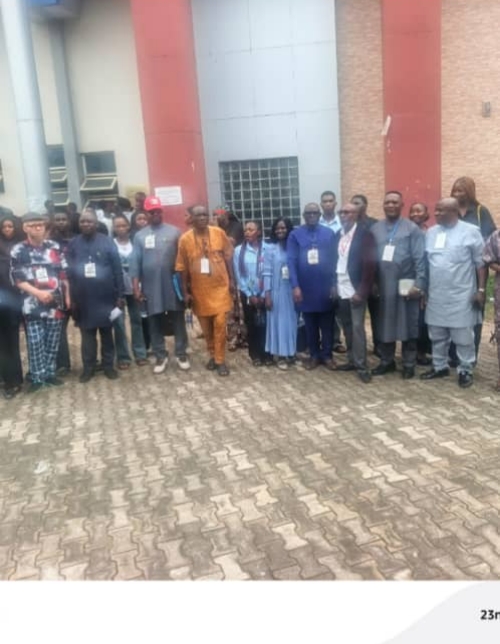
The Department of History and International Studies, Ambrose Alli University (AAU), Ekpoma, Edo State, in collaboration with the Confronting Atrocity Project of McMaster University, Canada, hosted an international conference on “Leadership, Democracy and Peace Building in Nigeria”, recently.
The conference brought together scholars, researchers and practitioners from History, Political Science, International Relations, Education and other related disciplines to interrogate some of the critical challenges confronting Nigeria’s democratic development, security and peace-building efforts.
The conference took place against the backdrop of persistent insecurity, political tensions, institutional weaknesses and other socio-political challenges with far-reaching implications for democratic governance, national cohesion and development.
It provided an important intellectual platform for examining the complex relationship between political leadership, democracy, security, peace building and national development, while exploring practical pathways towards strengthening Nigeria’s democratic institutions and creating the conditions necessary for sustainable peace.
One of the central conclusions that emerged from the conference was that peace remains a critical foundation for democratic consolidation, nation-building and sustainable national development.
Participants broadly agreed that democracy cannot thrive in an environment characterised by persistent violence, insecurity, political exclusion, weak institutions and declining public confidence in governance.
They therefore called for greater attention to peace building, inclusive governance, institutional strengthening, credible democratic processes and responsible leadership as essential components of Nigeria’s quest for stability and development.
Proceedings of the First Day
The opening day featured lead presentations, goodwill messages and an interactive virtual session involving students of Ambrose Alli University and a representative of McMaster University, Canada.
The first lead paper was presented by Professor Efosa Oseghale, Professor of History and International Studies at Ambrose Alli University, Ekpoma, who also serves as Dean of Students’ Affairs and Chairman of the Local Organising Committee.
Professor Oseghale focused on the relationship between peace, democratic consolidation, nation-building and national development. He argued that lasting peace provides a critical foundation for political stability, social cohesion and sustainable development.
According to him, no society can achieve meaningful and enduring progress where political violence, insecurity and social instability remain persistent features of everyday life.
He stressed the importance of peaceful coexistence, tolerance, dialogue and responsible citizenship, noting that these values are essential not only for preventing violent conflict but also for strengthening democratic governance and creating an enabling environment for development.
The second lead paper was delivered by Professor Cyrille Ngamen Kouassi of Glorious Vision University, Ogwa, who examined the relationship between leadership, democratic governance and peace building in Nigeria.
A major issue arising from his presentation was the responsibility of political leadership for creating conditions conducive to peaceful coexistence, political participation and sustainable development.
The presentation reinforced the broader argument that leadership quality matters significantly in determining the strength of democratic institutions and the capacity of the state to respond effectively to social, political and security challenges.
Also contributing significantly to the opening-day proceedings was Professor Bonny Ibhawoh of McMaster University, Canada, whose presentation emphasised the importance of collaboration in addressing the interconnected challenges of peace, democracy and nation-building.
Professor Ibhawoh, who acknowledged Ambrose Alli University as his academic root, brought historical and institutional perspectives to the discussions and helped situate some of Nigeria’s contemporary challenges within a broader historical and international context.
The lead presentations provided a strong foundation for subsequent discussions on political leadership, democratic governance, insecurity, peace building and national development.
VC Calls for Policy Position Paper
Another significant moment on the opening day was the goodwill message from the Vice-Chancellor of Ambrose Alli University, Professor Eunice Omozejele, delivered on her behalf by the Deputy Vice-Chancellor (Academic), Professor Osagie.
The Vice-Chancellor commended the organisers for bringing together scholars and experts to engage in an intellectual examination of issues that are particularly critical to Nigeria’s present circumstances.
She emphasised the importance of sustained academic engagement on leadership, democracy, peace and national development.
The Vice-Chancellor further recommended that the major issues, resolutions and recommendations emerging from the conference should be consolidated into a comprehensive position paper.
She suggested that the document be submitted to the Chairman of the host Local Government Area and that copies be deposited in the University’s repository for future academic and policy reference.
The recommendation was considered significant because it provided a practical mechanism for ensuring that the intellectual contributions generated at the conference would not remain confined to the academic environment but could also feed into public policy discussions and institutional decision-making.
AAU Students Explore Postgraduate Opportunities at McMaster
The opening day also featured an interactive virtual session between students of Ambrose Alli University and a representative of McMaster University, Canada.
During the session, the McMaster representative provided information on postgraduate study opportunities, including the processes and requirements involved in applying for graduate programmes.
Students were given the opportunity to ask questions and receive clarification on postgraduate admission and related academic opportunities.
Beyond its immediate educational value, the session demonstrated the potential of international academic partnerships to promote student development, research collaboration, academic exchange and postgraduate advancement.
Proceedings of the Second Day
Plenary Sessions Focus on Security, Elections and Institutional Reform
The second day of the conference was devoted largely to plenary presentations by scholars drawn from different academic disciplines.
The papers addressed a wide range of issues, including political leadership, insecurity, security governance, electoral technology, democratic consolidation, university governance, nation-building and vote buying.
The diversity of the presentations enabled participants to examine Nigeria’s democratic and peace-building challenges from multiple perspectives while highlighting the interconnected nature of the country’s political, institutional and security problems.
The plenary sessions opened with a presentation by Professor Julius O. Unumen of the Department of History and International Studies, Ambrose Alli University.
His paper examined the relationship between political leadership and the escalation of insecurity in Nigeria’s Fourth Republic, with particular attention to the period between 2015 and 2026.
The presentation considered the role of political leadership and the capacity of state institutions to respond effectively to Nigeria’s persistent security challenges.
One of the key arguments was that African leaders need to critically reassess inherited colonial institutional structures and explore ways of reforming them to meet contemporary political, social and security realities.
Professor Unumen consequently called for stronger, more responsive and accountable state institutions capable of delivering good governance, security, justice and essential public services.
Rethinking Security Governance
Another presentation, delivered virtually by Ruth Aigbe, a Research Fellow at the Nigerian Institute of International Affairs (NIIA), examined the question of governing security and building peace in contemporary Nigeria.
The presentation drew attention to the importance of effective security governance and appropriate institutional responses to the country’s growing security challenges.
It advocated a broader understanding of security that goes beyond military and other coercive responses to include good governance, social inclusion, institutional legitimacy and the ability of the state to respond meaningfully to the concerns and needs of its citizens.
The presentation reinforced the view that sustainable peace requires not only the suppression of violence but also the creation of political, economic and social conditions that reduce the grievances and vulnerabilities that often fuel conflict.
Electoral Technology and Democratic Credibility
Dr Anthony Osazuwa of the University of Benin presented a paper examining the implications of the introduction of the Bimodal Voter Accreditation System (BVAS) and the INEC Result Viewing Portal (IReV) for electoral processes and outcomes in Nigeria.
The presentation examined the role of electoral technology in the broader effort to improve the credibility, transparency and efficiency of elections in the country.
While acknowledging the potential of technology to strengthen electoral administration, the presentation stressed that technological innovation alone cannot guarantee credible elections.
Its effectiveness, it argued, ultimately depends on the integrity, transparency and capacity of the institutions responsible for administering elections.
The discussion therefore highlighted the need to combine technological reforms with institutional accountability, transparency, effective electoral administration and measures capable of restoring public confidence in Nigeria’s electoral process.
Democratising University Governance
Professor Austin Ojugo, Dean of the Faculty of Education, Ambrose Alli University, presented a paper on the need to democratise university governance in Nigeria, with particular attention to the recruitment and appointment of principal officers within universities.
The presentation broadened the scope of the conference by demonstrating that democratic principles are relevant not only to national political institutions but also to the governance of public institutions such as universities.
Participation, transparency, accountability and institutional autonomy featured prominently in the discussion.
The presentation suggested that universities can strengthen their legitimacy, effectiveness and public confidence when governance processes are guided by clear procedures, accountability, transparency and meaningful stakeholder participation.
Leadership, Nation-Building and Vote Buying
Other presentations included a paper by Dr L. S. E. Enato, which examined issues relating to leadership and nation-building.
Dr B. U. Okogbosun, Acting Head of the Department of History and International Studies, Ambrose Alli University, presented a paper on the implications of vote buying for democratic consolidation in Nigeria.
The presentation drew attention to the damaging consequences of vote buying for electoral integrity and democratic development, reinforcing the need for reforms capable of promoting political participation based on ideas, policies and leadership competence rather than financial inducement.
Key Lessons and Emerging Conclusions
Taken together, the presentations demonstrated that Nigeria’s challenges in the areas of democracy, security and peace building cannot be treated as isolated problems.
Political leadership, electoral integrity, institutional reform, security governance, citizen participation, social inclusion and the overall quality of governance are deeply interconnected and collectively influence the prospects for national peace and development.
A recurring message throughout the conference was that peace must be understood as more than the mere absence of violence.
Sustainable peace depends on the presence of credible institutions, accountable leadership, justice, respect for the rule of law, social inclusion, political participation and citizens’ confidence in government.
The conference also underscored the importance of educating young people on dialogue, tolerance, responsible citizenship and peaceful political participation.
Participants noted that universities have a particularly important role to play in this regard, given their position as centres of knowledge production, critical thinking and leadership development.
The discussions further suggested that Nigeria’s democratic future will depend significantly on the ability of political leaders and institutions to respond to citizens’ legitimate aspirations, address insecurity, strengthen electoral processes and create greater opportunities for inclusion and participation.
Conclusion
The international conference provided a valuable platform for scholars and stakeholders to interrogate some of the fundamental issues shaping Nigeria’s democratic and peace-building trajectory.
Its central message was clear: there can be no sustainable development without peace, and there can be no enduring democratic consolidation without credible institutions, responsible leadership and an engaged citizenry.
The conference therefore represented more than an academic gathering. It was a call for a deeper national conversation on how Nigeria can strengthen its democratic institutions, address the structural causes of insecurity, promote inclusive governance and build a culture of peace.
The recommendation for the production of a comprehensive position paper from the conference proceedings offers an important opportunity to translate scholarship into policy.
If effectively pursued, the initiative could ensure that the ideas generated by the conference reach policymakers, educational institutions, civil society organisations and other stakeholders responsible for shaping Nigeria’s democratic and development agenda.
Ultimately, the conference reaffirmed the principle that peace building is not merely a response to conflict; it is an essential investment in democracy, national cohesion and the future of Nigeria.
Dr Okhiku Idonije, is the Secretary to the Organizing Committee and International Conference Correspondence.